

 |
 |
 |
 |
 |
|



2010
2009
2008
2007
2006
2005
2004
|
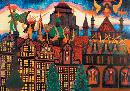
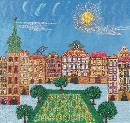
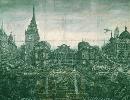
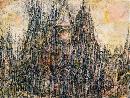
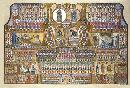
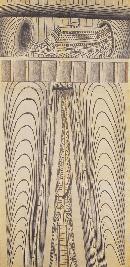
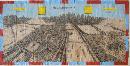
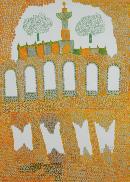
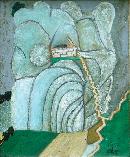
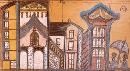
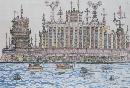
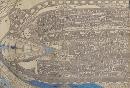
Magic Architecture Insita 2007 This section of the INSITA 2007 exhibition addresses the topic of ‘Magic Architecture’ through a selection of paintings by a range of artists of different nationalities and of different styles and creative temperaments. Our aim is to show that certain preoccupations and devices are common to these practitioners, none of whom knew one another; and also to ask the viewer to judge how far these artists might form a coherent grouping, and how far each remains a distinctive individual inventor. Our title invokes a recurrent topos in self-taught art, namely the representation of purely imaginary buildings – castles, palaces, cathedrals, temples, pagodas, railway stations, mansions, city blocks, towers and monuments, as well as utopian cities, and visions of a fantasmagorical megalopolis. In contrast to those ambitious three-dimensional constructions which are classified as Outsider Architecture – such as the Ideal Palace of the French postman Ferdinand Cheval or the House of Mirrors of the American recluse Clarence Schmidt – the buildings presented in this exhibition are all imaginary or purely conjectural. Because a painter has no need to adhere to the practical rules which govern the construction of real buildings, the architectures they portray tend to be freely improvised, highly imaginative and extravagant, and often weird or hermetic. The criterion of selection has been that each visual statement should strike the viewer as intense, startling, inventive or eccentric. The pictures we have chosen are all products of acknowledged exponents of self-taught art – Folk, Naïve and Outsider artists – and our selection is restricted to their drawings and paintings. In his treatise A General Theory of Magic (Esquisse d’ une théorie générale de la magie, 1902), the French ethnographer Marcel Mauss came to the conclusion that magic and its attendant belief-systems should be seen as a social phenomenon, based on “a collective synthesis, a unanimous belief – at any given moment – in the truth of a certain idea, the effectiveness of a certain gesture”. Magical thinking may spring spontaneously from an individual’s unconscious impulses and desires, yet its external application and formalisation rely on some form of social consensus. But can there never be such a thing as a magic which is practised on a purely individual and private basis? And if there were, how could its efficacy be judged? The question seems inseparable from the issue of how much importance we are prepared to attribute to subjectivity, and the way it shapes a person’s understanding of the world and his or her relation to it. We would not expect to find much magic at work in today’s sceptical and often agnostic society, for we can no longer assume widespread belief in magical conceptions. In our century, few give credence to things such as supernatural spirits, the power of certain persons (magicians or shamans) to effect astonishing transformations, and the invisible influence of special objects, buildings or places. Magic is now passé, ineffectual, an outmoded system which no longer inspires confidence. Nevertheless, it lingers on at the fringe of our modern consciousness as a kind of ghost – a ghost which might just return to haunt us. For there are certain people, certain things, places and occasions, whose aura of the uncanny seem to challenge our everyday certainties in regard to the predictability and knowability of the real. It is in the experiences of poetry, theatre and art, and sometimes in that of foreign travel, that a space seems to emerge within which intimations of the marvellous can subsist, as though a half-authentic residue of magic were still lurking in the margins of normality. Once we apply the concept of magic to the field of artmaking, we at once see its affinity with such phenomena as visions, dreams and daydreams, which tend to produce visual imagery of a distinctive kind. In ordinary circumstances, we deem such imagery to be implausible and impalpable, and have no hesitation in declaring it unreal. However, psychoanalytical and related enquiries into the realm of the Unconscious have, of course, alerted our culture to the metaphoric potential, if not the outright truth, of such material, while highly imaginative artworks can seem to open up zones of contemplation which lie beyond the orbit of our material concerns. In short, a potential for magic may be sensed within the practices of artistry, for, when we look at pictures, we have a tendency to lower our critical guard and to accept at face value what is in truth a mere hypothesis or mirage. It was the Romantic poet Novalis who, pursuing his doctrine of Magic Idealism, once wrote in his notebook that artists and poets were people who were prepared to handle external objects as if they were ideas, and to treat ideas (internal objects) as realities. The idea later crystallized in André Breton’s surrealist motto: “The imaginary is that which tends to become real”. I believe that what this exhibition demonstrates is the great diversity of architectural constructions that have arisen in the field of self-taught art. Typically, these are inventions developed within the sphere of the imaginary and in defiance of standard architectural convention – for real architects have at the very least to submit to the law of gravity and to practical restrictions on the choice and malleability of materials. Paintings by mediumistic artists like Augustin Lesage and Madge Gill depict otherworldly temples and palaces which could never be re-sited in the practical world we inhabit: were we to guess at their building materials, we would have to say that they employ a substance unknown to science, something highly paradoxical, like an impalpable solid. The inventions of Alois Wey may be reminiscent of locales in his native Switzerland, but as architectural structures, they have no footing on the earth we know, and would defy reproduction by the most able engineers. The confined compartments, alcoves and tunnels which form the obsessional and prison-like environment pictured by Martín Ramírez are conceivable only within a spatial and temporal dimension cut off from our own. In his drawings, Jean-Pierre Nadau allows his fantasy free rein, and spurns all sense of plausibility in elaborating outrageous buildings within which people are seen happily to stroll and congregate. There is much latent humour in Nadau’s imaginings, but the fundamental joke is that we, as viewers, are being coaxed into seeing these cockeyed sites as potentially real. For his part, Drago Jurak generates great proliferations of pagodas and palaces, laid out on separate levels that suggest a carefree magic capable of summoning up countless prospects of Utopia. As the American architects Donlyn Lyndon and Charles F. Moore observe in their treatise on the impact of architectural detail, Chambers for a Memory Palace (1994), “ornament clarifies the voice of the structure”. Jurak’s embellishments, tremulous and exuberant, seem to whisper to the viewer in a tone of ecstatic and otherworldly reverie. What I am arguing, then, is that such magical structures, delineated in painstaking detail, appear so serious and convincing that we can be seduced into thinking they exist – somehow, somewhere. Even as one part of our consciousness rejects them as ‘impossible’, another may be tempted to accede to their air of veracity, or what Vladimir Malekovic, in his essay ‘The Nature of Primal Art’ (1974), calls “a hallucinatory accuracy of expression”. That frenzied mental traveller Adolf Wölfli derived many of his architectural designs from imaginary journeys to places in North America and up the Amazon river, insistently naming sites that seem to certify his visions as actualities. The thrilling architectural designs of Herman Bossert and Marcel Storr can in a sense be explained as exaggerated renderings of the slender pinnacles and spires we associate with Gothic church architecture: yet as representations, they are so far-fetched that they undermine our inclination to recognize something familiar and instead bully us into believing we are suddenly elsewhere, cut off from what we know. Estrangement (dépaysement) is the sensation of being – momentarily at least – taken on a journey of the mind into a realm separate from the one where our body remains rooted. Such a journey can be frightening, or it can be envigorating. The visionary prospects imaged by Emanuel Navratil are like aerial photographs mapping a new world. As viewers, we float high above these insanely symmetrical ensembles, as if weightless, hypnotized into believing in the necessity of the unreal. Navratil’s mandala-like patterns may even inspire sensations of awe, as if we were in the grip of a sacred spell. In many of his architectural pictures, Franz Huestedde produces a stereotyped image of flat elevations, as if copying a child’s cardboard toy which has been flattened out. In the drawings we are showing here, his imagery becomes far more secretive and enigmatic: he appears to be quoting details of the interior of some unnamed building, where decorated alcoves and archways allow glimpses into a next-door room, albeit a room which seems flattened, without recession. There is something subversive about these visions, perhaps explicable in terms of their wilful suppression of perspective and depth, as though the imagined room were to invite us in, only to reveal itself as an airless diagram. More obviously ethereal are the colourful towns dreamt up by Yeshayahu Scheinfeld. Like fragile paper cut-outs, they signal some half-abstracted dimension of existence, evoking chimerical habitations beyond normal access. Karl Junker’s delicate paintings of castles, each piece surrounded by a defensive frame of roughly cut wood, refer to sites in the locality of his hometown, Lemgo, but are manifestly less indebted to actual prospects than to an imagination steeped in a stylized medieval iconography. Artists like Nikifor, Germain Tessier and Emerik Fejes frequently draw inspiration from real places, and are not averse to copying from old postcards and photos; yet their transcriptions incorporate an entirely subjective colouring and mood, each painted structure marked by the artist’s subjectivity. For his part, Matija Skurjeni presents a softly enhanced impression of Marseille, a city he had once briefly visited, so that a genuine memory modulates into a bittersweet caprice, a figment of yearning. Here is almost an allegorical portrayal of the process of nostalgia, and our viewer’s investment in the image can in turn awaken echoes of places we have visited in our own dreams, or perhaps – who knows? – in our real lives, but in circumstances whose corroborative detail we cannot recover. In his highly theatrical and even hallucinatory re-enactments of his encounters with actual sites and structures, Willem van Genk shows no compunction in taking full possession of named cities and turning them into gigantic, pulsating conglomerations of his own, implementing photomontage and collage as well as pencil or brush so as to achieve a monumental fusion of proliferating components within a global whole. His version of Moscow is like no city we have ever visited; it is a nightmare creation, a tentacular monster that makes us recoil in awe. And yet – in common with George Widener’s expanding Megalopolis – it is surely something we recognize, perhaps because our own experience of large cities has fostered a disturbing new mythology within our minds, so that we are, in effect, already conditioned to see such a fabricated structure as real – or rather, all too real. Visionary imagery such as this may shock or intrigue us, but it is unlikely to make us permanently alter our judgment of its lack of veracity. We would be mad to believe in magic nowadays. Nonetheless, whenever we entertain a fancy, we do submit to a kind of temporary madness, and madness is no laughing matter. It is hoped that the selection of works in this exhibition will communicate the utter earnestness of the visionary project. Furthermore, each dream made visible to others can surely be construed as the material record of a set of subjective feelings – and we must remember that emotion is always experienced as entirely real by the individual concerned. Assenting to the individual’s right to believe in his private magic may be a first step towards the “collective synthesis” posited by Mauss. If it is true that the participants in this exhibition have all responded to the urge to give persuasive expressive form to otherwise invisible impulses, these impossible constructions may finally imply a powerful metaphor of creativity itself. Certainly they correspond to the creative subject’s yearning for psychological coherence and stability. In his study of the unconscious drives underlying human architectures, Psychology of the House (Psychanalyse de la maison, 1972), Olivier Marc, a French architect and psychoanalyst, observes that “we construct ourselves according to a diagram of growth which the house discloses, and dreams about houses reveal […] different stages in the elaboration of the self”. In this regard, it becomes possible to envisage a painter’s architectural construction as a clue to the parallel consolidation of his selfhood. The painted palace or city is thus a symbolic blueprint of the psyche. The magician’s whole art is to dwell within his fata morgana long enough to feel at home therein and to draw strength from its shape-changing versatility, a versatility which, in truth, is afforded by its very insubstantiality. Modern magic lies in the capacity to exert metaphoric power through the succession of objects proposed by the imagination. It is of course entirely likely that the expressions of these idiosyncratic artmakers will continue to seem incompatible with the sum of practical and theoretical knowledge which a majority of people share. They may in this sense be deemed aberrant and uninstructive. However, studies of self-taught art have repeatedly shown that independent creators – people such as Willem van Genk, Madge Gill, Armand Schulthess, Zbynĕk Semerák, and Adolf Wölfli – are capable of devising the most elaborate ‘private worlds’, in the sense of mental schemes of incredible depth and complexity, configured in visual documents of a tenacious purposefulness and density. As the Dutch architectural critic Koen van Synghel writes, in an essay on what he calls the “instinctive architecture” figured in Outsider Art (‘Je ne peux vivre que dans mes dessins’, 2007), “architecture is by definition a world of ambivalence, of personal utopianism, a refuge for thought or, in the absence of rationality, a refuge for instinct”. To ignore or to belittle these artists’ painstaking constructions of Otherness, with their glimpses of ardent feeling and intimations of the sublime, would be to succumb without protest to what is rudely thrust upon us in actuality and thereby to submit to a fatal error, that of supposing that real-life architecture – and by metaphoric extension, the real social, political and emotional constraints which exert a dominion over our daily lives – represents something absolute, something indisputable and therefore unchangeable. The magicians of art are there to remind us that the imagination is always the oppositional source of fresh alternatives. Roger Cardinal up | |
|








© 2005 Slovak National Gallery. All Rights Reserved. Web satori.